

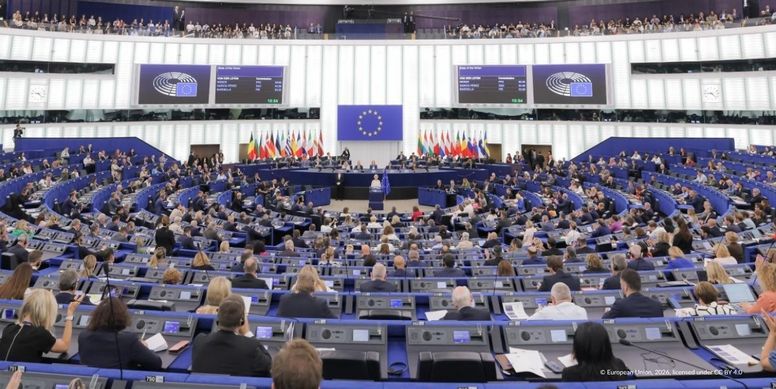
On 10 September, European Commission President Ursula von der Leyen took the floor before the European Parliament to deliver the 2026 State of the Union address. Held every September, the speech takes stock of where Europe stands and sets the Commission's political direction for the year ahead.
For anyone following EU policy in Brussels over the past year, one word has been particularly difficult to escape: competitiveness. Skills and labour market needs have moved to the centre of the political debate, shaping new initiatives, negotiations on the next Multiannual Financial Framework and the development of EU programmes.
Against this background, von der Leyen's emphasis on putting people at the centre of Europe's future was a welcome signal. Yet many issues directly affecting young people received only limited attention. Recent developments on skills, housing and employment point in a positive direction, but a broader question remains: where do young people fit into Europe's plans for the years ahead?
Erasmus+ was not among the headline priorities of the speech, but its impact still made its way onto the stage. Von der Leyen shared the story of two young people from Poland and Finland who met through Erasmus and later created a successful technology start-up. Their story illustrates the wider impact of learning mobility. Erasmus+ enables people to study and train abroad, but also brings together diverse perspectives, facilitates the circulation of knowledge and ideas, and creates networks across borders. These experiences contribute to innovation and Europe's competitiveness. Their value should therefore not be overlooked as negotiations on the next EU budget and Erasmus+ programme advance. If Europe wants to strengthen its competitive edge, it must also invest in the conditions that allow people, knowledge and ideas to move across borders.
The same applies to the growing focus on skills. As the European Pillar of Social Rights approaches its tenth anniversary, developing new competences is only part of the challenge. Young people also need a fair transition from education to the labour market, with quality traineeships that provide genuine learning experiences and appropriate working conditions, followed by access to quality jobs where they can put their skills into practice.
But even the best education or employment opportunity means little if a young person cannot afford to take it. This is why von der Leyen's statement that “housing is a right” deserves particular attention. Across Europe, access to affordable accommodation increasingly shapes where young people can study, work and participate in mobility. Housing is therefore one of the conditions for making Europe's education and mobility ambitions possible. The State of the Union also reflected the EU's ambition to strengthen its international partnerships, including through Global Gateway and closer relations with its neighbourhood. Education and learning mobility should be part of this agenda, particularly as Europe prepares for a possible new wave of enlargement and candidate countries strengthen their capacity to participate fully in Erasmus+. Expanding mobility also means addressing the barriers that prevent students from accessing it, making the intention to modernise the Schengen visa framework and keep Europe open to international talent a welcome step. In the Mediterranean, the new Youth Skills and Jobs Initiative and the broader focus on skills should be accompanied by renewed attention to higher education. Almost twenty years after the first Euro-Mediterranean Ministerial Conference on Higher Education, a second conference has yet to take place. Renewing this dialogue would be particularly relevant as students and academic communities across the region continue to face the consequences of conflict.
Perhaps the most unexpected development for international education came from across the Atlantic. Canadian Prime Minister Mark Carney spoke of enabling young Europeans and Canadians to “work, study and live on either side of the Atlantic”, opening the prospect of a new phase in EU–Canada mobility. Erasmus+ already provides a foundation for cooperation, but greater ambition also raises questions about accessibility and reciprocity. Transatlantic mobility comes at a high cost, making adequate financial support essential. At the same time, with both Canada and the EU seeking to attract and retain international talent, any future framework should create genuine opportunities in both directions. If designed around these principles, closer EU–Canada cooperation could offer an interesting model based on mutual exchange rather than simply competition for talent.
Another significant signal was easier to miss. In the Letter of Intent accompanying the State of the Union, the Commission announced “European Universities 2.0”. What this will mean remains unclear, but the announcement comes at an important moment. European University Alliances face growing expectations to demonstrate their added value while developing more sustainable funding models. Their next phase should therefore be measured not only by deeper institutional cooperation, but by what students experience in practice: greater mobility, access to learning opportunities across institutions and meaningful participation in governance. A renewed commitment from the Commission would be welcome, with students involved in shaping what comes next.
The 2026 State of the Union set out a wide-ranging agenda for Europe's future. Education and learning mobility may not have occupied the centre of the speech, but they are closely connected to many of the objectives it seeks to achieve.
The challenge now is to translate political commitments into policies, programmes and funding that deliver in practice. Students and the organisations representing them should be involved in this process from the outset — not only as those who will experience the results, but as partners in shaping them.
Europe is defining what it wants its next chapter to look like. The next generation should not only be expected to deliver it, but also be given the means and the voice to help write it.
Follow ESN